Showing posts with label Gratitude. Show all posts

Tuesday, January 5, 2021

Whales, trails and touching bottom

Tadoussac is one of those picturesque spots where under a thousand people live in the winter, but easily three times that number work and play there in the summer, including sail racers...even during the pandemic!

Day 40 to Day 46, Tadoussac, QC to Ste Anne-des-Monts, QC (days 20 to 22 of sailing)

We pulled into Tadoussac mid-afternoon after an exceptionally calm motor from Cap de l'Aigle and some whale and seal sightings. The current from the Saguenay River where it met the St. Lawrence was noticeable, but we had timed the tides to avoid drama and docked with only a little bit of it...we couldn't see the numbers of the assigned dock and ended up just throwing our lines to friendly fellow boaters in a mixture of English and French. Tadoussac would be the last place we would visit where we could expect a) at least a few speakers of basic English and b) a standard sort of Quebecois French that we didn't find occasionally baffling.

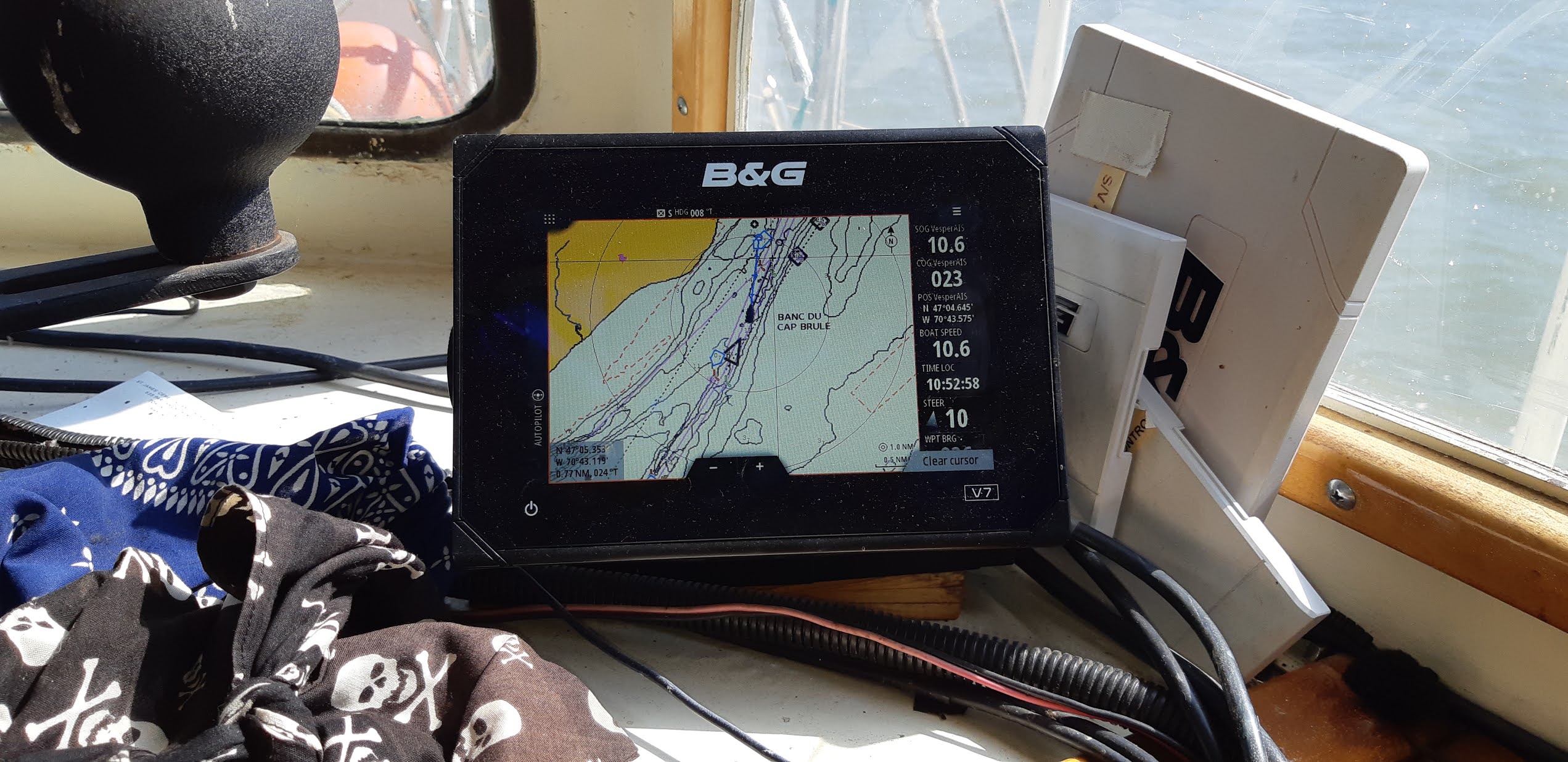
As an example of how steep the east side of the marina entrance is, this is what the sonar revealed.

The tidal range at Tadoussac, as was the case until "around the corner" of the Gaspe peninsula, was impressive at around five to six metres. The sloping seabed both in front of the beach and to the right, inside the marina, made for some interesting vistas.

Tadoussac is known for its whale-watching boat trade, and it's a busy one. We were somewhat shocked at seeing crowded smal ferry-type ships carrying about 400 passengers leaving and returning several times a day to the adjacent docks, many without masks. We saw more strict mask use in the village's grocery store, which was more eclectically stocked than most in rural Quebec with various cheeses, drink options and charcuterie, which we assume was also due to the high volume of summer visitors. Places to buy local crafts, visit historic sites (for a place occupied for over 420 years, the village has seemed to have limited appeal as a place to live year-round), and it's a pretty place to explore, if requiring good legs for the steep hills. But the crowds seemed surreal to us; not only as sailors are we generally solitary by nature, but the pandemic did not prepare us for hordes of people, many unmasked, that we encountered in Quebec City and this small place.

"BEER": Seems to be a word that transcends language when socially distant.
Of course, in hindsight, the failure to mask, as well as the close-quarters barbeque we avoided at the yacht club on our second night there, seems at the time of writing to have backfired, badly. Nonetheless, we enjoyed our couple of days there and planned for the next stop in the increasingly small and isolated number of ports ahead of us as we trended NNE down an ever-wider St. Lawrence.
After we left Tadoussac, we saw, unusually, we thought, a US Coast Guard cutter travelling up the St. Lawrence. We learned later that it's part of some exchange program in which Canada and the U.S. can operate in each others' waters for "security reasons". Does that smell tinny to you?
Without having to take the pandemically and environmentally questionable whale-watching tours on offer, we saw so many surfacing whales on even this short stretch (plus seals and interesting sea birds) that we lost count; I was kept busy helming away from the whales we saw as I did not want to get particularly close to any potential cetacean mum/offspring pairings.

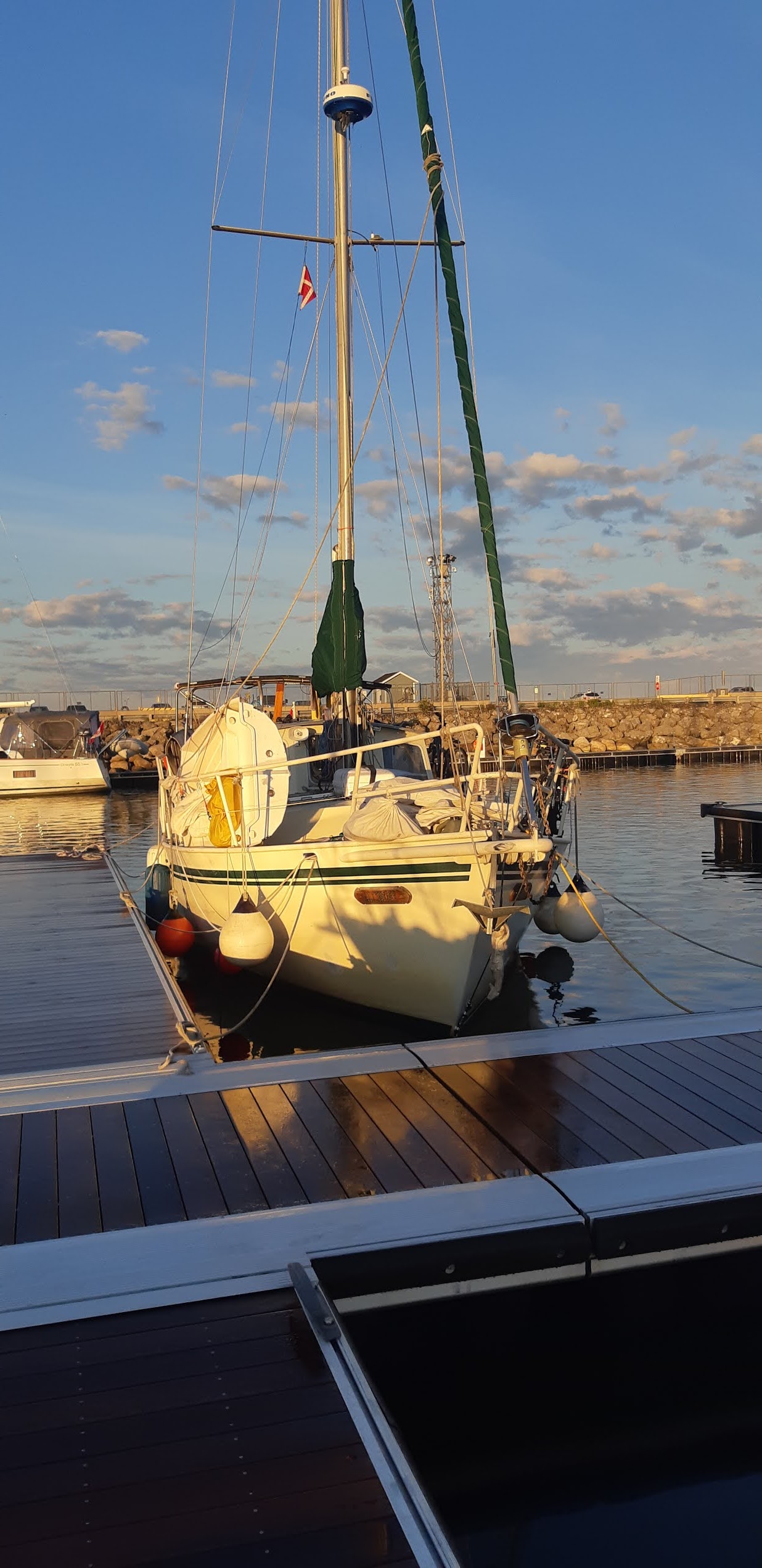
Alchemy at Rimouski Marina, a well-equipped spot where we stocked up as the options downriver really started to narrow even as the tidal ranges expanded.
Passage planning is always a factor in cruising: the crew never can be sure that diesel will be easily obtained (as in "on foot or on bicycle"); that food and drink will come in the variety or amounts desired for a good stock-up; or that the smaller places will be even open to any boats beyond those belonging to the locals. So examination of cruising guides (this one was very helpful), paper charts (preferred by us for planning trips and working out distances and therefore likely time spent in transit via walking the dividers) and weather concerns based on as granular forecasts as we could obtain. More than once, the weather for us either failed to materialize as predicted, or, in places, was much stronger than forecast and/or was from the NE direction (wind over current), which we had been warned was not worth bashing into and, closer to shore, could prove dangerous. Despite our desire to get
Rimouski's marina had some beautiful, seaworthy boats, as might be expected: This was a Fisher 34 motorsailing ketch...
The under 50 NM trip from Tadoussac to Rimouski actually involved a spot of navigation: we crossed from the north to the south side (actually NNE to ESE, but we were used to pretending, at closing in on 49° North, that we were "making our easting" when in fact we were pointing at Newfoundland's west coast). This brought us into variable, but far from gale-strength, winds, rain and fog. As we were passing some islands (L'île du Bic and some of its smaller offspring), we even turned on the radar, even though the ship traffic was relatively light and more or less distant. All had cleared by our suppertime arrival.
...and this was a vast Beneteau Oceanis 55 off our stern.

Arrival at Rimouski only required elevated French, which I had been trying to restore, to reserve, via a phone call or over the VHF, a designated slip. We also found it necessary to mention our draft (1.9 metres, or 1.8 m. plus a margin for waves inside the marina) so we could tie off appropriately should Alchemy "touch bottom" at lowest tide.

The keen-eyed will note that this tender has travelled a long way from Mimico Cruising Club.
Rimouski is a middle-sized town of some 50,000, as opposed to the big villages more common in the Gaspésie, and had a Canadian Tire, so we picked up several of the "one-pound" Coleman canisters we used on the on-deck barbeque. We also started to select foods suitable for "at sea" snacking, as we hadn't decided at this point whether we were going to go "inside" to Nova Scotia via the Northumberland Strait; or divert to Gaspé city itself; or just head out into the Gulf of St. Lawrence to les Îles de la Madeleine and then to Sydney, NS at the north end of Cape Breton.
No, I never learned what happend to Steve Martin I.
All available options required fresh nautical charts, appropriate weather windows, and full tanks and rested crew. The first provisional stop was the slightly smaller than Rimouski town of Matane. We balanced the relatively short 45 NM run against a gale warning that, coming from the west, would have aided us, and decided to give it a go on August 25.

Alchemy at the far eastern end of the compact marina at Matane. Yes, we "bounced" here.
The gale warning manifested, unfortunately, as we came down the narrow entrance to the Matane Marina. We had been assigned a slip part of the way toward the northeastern end, but our attempts to turn into the slip were defeated by SW gusts to about 40 knots, insofar as I was able at the helm to pay much attention. And no, I don't think a bow thruster would have helped much. We ended up at the far end, more or less plastered against the dock. We didn't count on the strong southwesterlies to keep us there for a few days.
Windswept, the Matane shore was just at the point where the north shore of the St. Lawrence could be easily seen, although the clouds above it suggested the land below the horizon.

It wasn't a bad thing. Matane had grocery stores and hardware supply places within longish walks, and the weather, while steadily cooling off as August waned, was pleasant save for one gusty and rainy day. At this point, almost all commercial transactions were in French, so I was kept très occupé if at a loss sometimes for certain terms . Given that I hadn't spoken regularly in French for four decades, I didn't self-castigate.

Bottled up: We warped off and had a fellow push our bow off one of the docks to the right, and still had trouble making our turn out of here, the wind from the south west was heavy and constant.

Steady and sometimes strong SW winds kept us in Matane for four days until August 29. During that time, we settled more or less lightly on the bottom at low tide, a situation that, I realized, was not particularly dangerous, but which caused me to double up some lines in case the wind reversed and we were being blown off the dock. This didn't happen, and in fact the wind remained so strong that we burst a fender on the dock. That's fine, fenders are expendable and half of our cylindrical "Taylor-type" are ones more fastiduous boaters have thrown away for us to salvage.
Speaking of recycling, this old fishing boat is now evidently a Matane hotel's garden shed. Note the masts of the marina in the background revealing the tidal range in the well-protected basin in every direction excepting SW winds...
We've never hesitated to reuse and recycle marine gear when appropriate, because we dislike waste and we simply do not have the kind of "dock queen looks" with Alchemy that make us particularly interested in impressing others. We have no objections as to how others choose to enjoy their boats, and it is very clear to us that pristine varnish and surgically clean topsides are aspirational to many, but this is hard to achieve on an ocean-capable vessel, where function tends to top looks, and a slightly off-colour paint touch-up resists rust as well as a complete redo in Awlgrip.
Ugly, yes, but the cable ties were further insurance to keep the "keeper" secure.

During our wait for a break in the wind sufficient for us to get out of the basin and back on track for the far end of Quebec, we made a further refinement to the rudder pin repair, even as I had to admit the water was getting somewhat chilly for sub-surface rachet and wrench work. I was pleased to acquire some spares at a local quincaillerie (hardware store) entirely in French, thanks to some prewritten cribn notes for unfamiliar terms, such as grand collier de serrage, or "large hose clamp". I would only check and slightly dog down the nuts again in Gaspé and during our self-isolation in Port Hawksbury, after which we were fine all the way to haulout on Nova Scotia's South Shore...but I'm getting ahead of events.
It was downriver from Matane that the shoreline really amped up the drama. The mountainous region here is called "Chic-Choc" and the locals make a nice rum with that name we were able to sample.

After an "exciting" departure involving getting our bow swung off the end of a dock by one of the huskier marina employees, Alchemy being reluctant to turn to port at low speeds with a breeze on the beam, even when warping off, we ventured to our next stop in increasingly calm waters another 45 NM to Ste. Anne-des-Monts, a town of some 7,000 folks, about two of whom spoke English, a pattern that would persist jusqu'à ce que nous naviguions au coin de Gaspé.
Approaching Cap Chat, about 10 NM short of Ste. Anne-des-Monts and one of the 'bumps' on the coastline that was much more impressive in reality than on the chart.


This unilingual French situation was not as much a problem for me as was the Gaspésie accent, which was different to my ear from that of both Trois-Rivières and that of Tadoussac. I suspect this was in part due to the evident problems with dental care as we reached the smaller villages downriver, but it made for some interesting miscomprehensions, particularly when my rusty French and groping for words or more complex verb forms exceeded more than the English of the locals gleaned from bilingual package labelling or perhaps distant radio or TV stations. On the other hand, it was nice to visit places virtually untouched by cable television and clearly underserved by internet access, although we were always able to get a couple of bars on the ship's wi-fi for things like weather forecasts.
Big sky country, but those clouds were always whipping past.

We would need those forecasts with the advent of September at the 49th degree of latitude.

Sunday, October 25, 2020

Under full stream

The prudent sailor takes information where she can get it. This port-to-port distance chart helped in our passage planning, although I had to squint.

Day 31 to Day 39: Quebec City, QC to Tadoussac, QC (days 18 to 19 of sailing)

We came and went through the city of Montreal without, save for a bike trip to a chart shop by Mrs. Alchemy across the Jacques-Cartier Bridge, with little touristic activity. Partially, this was due to our habit of sticking to the Seaway/big ship channel rather than diverting to "downtown" yacht clubs, and partially this was because we wanted to avoid crowds and, we hoped, COVID. We were determined not to pick up the bug not only due to the potential health risks, but because two weeks stuck on a boat ill was a worse alternative than two weeks stuck on a boat in self-isolation once we reached the "Atlantic Bubble" and a reasonable prospect of making our appointment with our winter shipyard destination.
Thanks to the magic of cross-referencing charts, I was able (in French, yet) to obtain the correct model to restock our spares.

So while the Montreal south-side suburb of Longueuil had the ability to meet our needs, we didn't actually see much of Montreal itself. Quebec City was different: it's more compact and while the opportunities for tourism per se were considerably muted this year, and rightly so, we did get to see a fair bit of it.
The housing on parts of Boulevard Champlain beneath the Cliffs of Insanity below the Plains of Abraham struck me as dangerously hopeful in terms of not getting a boulder through the attic.

We have found our decison to bring bicycles aboard vindicated, even though special care had to be taken to turn handlebars sideways, to watch for lines snagging and to secure them to the rails. Grocery getting involved backpacks and bungee cords and sweat: Quebec City is plateaus and hills and cliffs for the most part and the narrowness of the shoreline on the river, so critical to its defense when run by the French, means almost any provisioning is going to involve a steep climb uphill and the smell of wearing brake pads on the return leg. While the actual sea air downriver from Quebec City certainly began to affect the bicycles in terms of corrosion, the benefits of not having to take public transit (where available) or taxis (ditto for the smaller places) have been significant, as has the chance to see from the saddle the more ordinary parts of town. And our legs and lungs are fitter than when we moved aboard.
"Leave out the back way" is not an option.
The Yacht Club de Québec, once we found it, its seawall rocks composed of boulders the same colour as the surrounding cliffs, was a very nice place and we finally got to have a socially distanced brunch instead of whatever we could grill up in the galley. Also access to decent showers, a laundry not closed by COVID and a proper chandlery nearby were all huge pluses.
Lucas and his beloved poutine in an otherwise empty cafe in old Québec
We had a "medical incident" when we were asked to change docks after a much-needed refuelling. Backing down, I came a little too close to the stern rail of a docked boat, and she attemptied to fend off, cutting her thumb in the process. She freely admitted that it was unwise to put her hand between a moving (if ever so slowly) 16-tonne vessel such as ours and another boat and wrapped it up until we were back at dock. But when your animal rehabber wife tells you she required stitches, it was likely the case.

Why a thumb makes a poor fender.
A nice man from a nearby boat named Georges drove us to the closest hospital, which happened to be part of the University of Laval, and we waited about five hours to be seen. The actual stitching took about five minutes and Becky reports a "99%" recovery. The Québec health care system (despite the wait, there were more serious cases in front of us) seemd pretty efficient and cost us, as in our home province, nothing, but we were glad to get back to the boat that night.
Drive directly onto le chariot du bateau
One of the interesting sights at any yacht club is how they handle the practicalities of boat handling. In a strongly tidal place like Québec City, they favour the ramp and tractor over the Travelift approach. This consists of driving a wheeled frame at an appropriate state of tide and wind down a long ramp, driving the boat into said frame, lashing the boat to the frame and hauling it to wherever it needs to go in the yard. How they get the boat off the frame and onto jackstands or blocks wasn't clear, but it was mesmerizing to watch it done.

Regardez ce premier virage à gauche, et bonne chance!


On one of my Tour de France assaults grocery gets, not only did I take note of the beautiful neighbourhoods of the plateau's Sillery and Bergerville areas, but I also found a few interesting bits of signage. I believe, for instance, this is how my last name sounds in French, although it is an Anglicization of an Irish tribal name, I got to hear it read back to me all through la belle province.
If you are reading this on a phone, it says "Avenue Désy"

Around the corner was a little bit of horrible history and again, from a car, you'd miss these sort of things.
Seemed fishy to me.
Regardless, provisioned, rebolted, recovering and provided a pre-dawn tidal window (this was now a constant consideration in when we would leave a place, tempered by how far we thought we could get), we departed the city and headed ever eastward with an increasing compontent of north. Even a disconnected vent line on the shaft seal that put an alarming, but easily pumped out, amount of nearly Atlantic Ocean into the bilges was discovered and dealt with.
Sure, for you, this is a light jog. For Alchemy, it was a new record
We spent the first two to three  hours of our journey to Cap-a-d'Aigle, some 77 NM downriver, hammering into contrary tide with a side of wind that kept our speed down to about 4 knots. We did this to catch the turn of the tide partway around the south side of Ile d'Orleans, the large island in the St. Lawrence NE of Quebec City and to reach the "choke point" of L'isle-aux-Coudres. We had been counselled back at the club to go past this island at slack time, or at least with the last of it at our backs as it was very difficult to challenge the current at this spot.
This was with the current. Given my RPM at this point, I should have been doing maybe 6.2 knots.
That prospect was perhaps undersold. We had a ridiculous if rocky run and kept breaking speed records as we peeled around the end of d'Orleans.
Oh, you've got to be kidding me.
We got around the purported area of concern at about 8 knots, still fast, but manageable.  Cap-a-l'Aigle's marina was one of those that is hard to see  until you are practically on it, but it was in a beautiful, if increasingly rugged, setting.
Behold, the dawn cloud dragon.
The next day dawned very calmly, which allowed for an easy departure to Tadoussac. The river opens out considerably at this point and is some 10 miles across, so we could choose which "chenal" to take as there were far fewer concerns about depth and the buoyage remained excellently maintained, another reason we tended to stick to the shipping lanes.
Perfect for spotting whales. And seals. And gannets.
The run to Tadoussac was less than half of the previous day's tidal-current-boosted passage, but in reviewing the charts, I was a little concerned about the confluence of the Saguenay and St.  Lawrence Rivers in terms of the way the tide and current came out of the former fjord-like river at differing and sometimes contrary rates to that of the St. Lawrence. So, as has been so often the case, I had one eye on the clock and another on the river.
Seriously, an unusually calm day to drive a boat

Which is how I first glimpsed, even from the semi-restricted view from inside the pilothouse, my first whale dorsal fin since I was delivery crew on Bruce and June Clark's Bristol 45.5, Ainia, way back in 2009.

Lucas and Becky had spotted them, too, and this was about the first time I noticed the lack of a telephoto lens aboard. We lost count around 20 or so, and we also spotted a seal mum with a head the size of a garbage bin, and her cuter offspring, who was wearing a sort of kelp beret, as one does...alas, no footage as we were among other boats and had to focus on not hitting animals or vessels. As a side note, all those eyeballs forward caused me to notice what looked like a telephone pole vertically floating in the water, about 30 cm. above it. So I reported it to the Coast Guard, because that could seriously dent a sailboat.
Tadoussac is a busy place for sailing as well as whale-watching, and is very beautiful in spots.
We arrived at Tadoussac in the early afternoon, and after a bit of an issue finding our assigned dock, we settled in for some R&R. This was the place to do it, a village of 700 or so that swelled to service the tourism industry to about 3000. There's even a microbrewery. More in our next post.
Yes, the tide and the marina happily co-exist with that steep a slope in the channel.


Thursday, July 16, 2020

The matter of gratitude

Signalling our departure.

DAY 2: Cobourg Marina, Lake Ontario

Last few days in the home port and, of course, it's stinking hot here and has been for weeks and there's still a lot of jobs to do. But the forecast looks promising for Tuesday, the proposed departure date, and, while only a fool of a sailor hews to a schedule, it's not a Friday.

As we prepare to leave, it seems appropriate to express gratitude for all the people in our lives who helped us, either via encouragement or through very direct aid, to reach this point. No sailor is an island, after all, and while we have certainly done a lot on our our initiative to become sailors capable of sailing a good old boat, there have been some folk who've been constant sources of inspiration and sound advice. In alphabetical order...

Jonathan Bamberger: We met at a 2010 "Safety at Sea" course (at which I also met the renowned Herb Hilgenberg) and he was kind enough to let me on his crew for the 2010 Lake Ontario 300 race. It provided more than one teachable moment.

Andrew Barlow: Has seemingly fabricated half the stuff on our boat and is a hell of a nice guy, as well. No matter how odd the task, he has been able to turn my crude diagrams into reality. I hope to one day finally jam with him, seeing as he's building a studio.
Now, as intended, completely full.
Fred Blair: This pal of my father-in-law, Dave McMurray, from back in the '80s when both were in the boat building realm, really came through for us with a beautiful custom-made cabinet for our galley, which has solved a host of stowage issues and made our galley fully functional.

Paul Bond
was one of the first guys I met at our boat club over 20 years ago and he and his wife Ruth-Ann were unstinting in their good advice and, later, when I stopped ignorantly damaging our first boat, were supportive when our plans for long-term cruising began to take shape.


Do not refrigerate this man's red wine.

John Cangardel has been so enthusiastic over the years on our behalf that his erudite and constructive advice has reignited our anticipation of actually doing this trip. More pertainently, he encouraged me to take two RYA courses aboard, one in Brittany, for which I was not entirely prepared, alas, but also another in Antigua, for which I was. Endlessly supportive, John will be our spirit guide as we go to places he's already been. And he also took the photo that is the background of the blog...our wake upon leaving Toronto Harbour.
Bruce Clark versus an Atlantic gale. Best to stay hydrated.

Bruce and June Clark: Gave me my first offshore crewing experience, and I must say, it was a doozy. Completed their own circ a few years back, and we still have the Portabote they sold us and it's not yet entirely shot. Were I to be deterred by the realities of offshore cruising, this trip might have done it...but I remained enthused.

Jeff Cooper: A consummate sailor in both racing and cruising modes, and a shrewd judge of the human condition, we shared the care and feeding and costs of my first boat, Valiente, and stayed friends despite that! Jeff is a brilliant bargain-finder, and aside from his considerable knowledge of good gear, he's been responsible for our acquisition of durable gear at reasonable prices, without which refitting would have taken longer and costs us more. He is so gracious, he never complained when I think he aggravated a hernia helping me bring an absurd number of large batteries aboard.

Dan Erlich: Another Viking 33 owner, Dan and I became acquainted via a mailing list back in the dark days of the internet concerning the repair and maintenance of the Atomic 4 gasoline inboard. Dan seems to know everything there is to know about this vintage motor, and was generous with his advice and guidance when I had to rebuild not one, but two of them, sourcing a block and parts that still run 15 years later for the new owner. Inventive and funny, Dan made motor mechanic skills acquisition easy.

Goshka Folda and Earl Bederman: Since 1996 (pre-boats!), Earl and Goshka were my primary clients for my freelancing efforts as an editor and graphic designer, Goshka, who now runs the firm Earl started, kept me working steadily and were very supportive of our goals to cut the dock lines.

Jay German and Rob Lamb: Fellow steel boat liveaboards and cat fanciers, Jay and Rob have been a source of friendship and sound steel boat advice for many years, and I expect them to get out of fresh water shortly after we do. Rob is particularly skilled at the art of winter battening-down, which helped us overwinter our boat last year.

Ken Goodings and Lynn Kaak: The couple with whom I took my Canadian Power Squadron Boating Course in 1999 as a know-nothing squib weren't a couple then, but they got married and sailed away on a Niagara 35 and have been taunting us ever since with tales of tropical paradises. Well, we're coming out shortly! Ken has given us excellent advice on the mysteries of the single-sideband radio (we are installing one this winter...finally) and is another marine bargain-hunter, as are all the best sailors.
Ian Grant works on his tan and his Zen-like calm.

Ian Grant: Antiguan-based, unflappable RYA instructor who managed to pack five days of instruction into a four-day week for my first step on the RYA ladder.

Tony Johnson is a boat repair guy so booked you might get him for 2021...but he has been very generous in giving me advice that allowed me to solve a difficult fuel supply problem satisfactorily. He is one of the few people in the boat trade local to Toronto I would recommend unreservedly....but be prepared to wait.

Mitch Kitz works for Genco Marine, as did my wife Rebecca for a few years when our favourite chandlery was on Queen's Quay West. Mitch's encyclopedic knowledge of boat gear, and his frankness in sharing his opinions, has served us enormously well in making the right decisions and using the right materials and techniques. If Mitch doesn't know the answer, you may be phrasing the question wrongly.
Alex baffled that Cabo S. Vicente was not "a washing machine" the day we rounded it.
Alexandre Mathias Kossack, whom I only knew from an internet comment site and a phone call, allowed me to visit him in 2007 and help him deliver his 12 metre raceboat Giulietta, which Alex, an engineer, had a large part in designing. He showed me, and later Rebecca on a later delivery, every courtesy. I didn't realize it when I met him, but he is one of the top amateur sailors in the world and competes now on a 53-footer at the ORC class level, and with a crew of Portugal's best young sailors. Boa sorte!

Suzanne Manvell has been "three-quarters" around the world by sailboat in her own right, and the love of boats brought her to us when we were attempting to sell our first boat, Valiente. While that didn't happen, we did become friends and Suzanne, a real estate agent par excellence (as well as a snappy dresser and a gifted dancer and party-thrower) ended up selling our Toronto home. When we missed our "departure window" in 2019, we decided to keep Alchemy afloat in a marina so as to make a quick exit in the spring. How that got sabotaged is still in the news, but, as we needed a place to stay, Suzanne unhesitatingly offered a flat in her house. This was after finding us a different flat post-house sale in 2018-19. Now I recommend her, again, unreservedly.

Dave McMurray is my wife's father, my son's grandfater, a former boat designer and builder and the man who didn't shoot me when, at age 31, I started dating his 19 year-old daughter. He has been unfailingly generous with his time and energy, including multiple trips shuttling possessions into storage, as has his wife Joan, and, despite knowing of our skills deficits, has been a great supporter of our efforts to get this old girl to the ocean.

Aubrey Millard, who, only coincidentally, was the husband of a dentist I had decades ago, owned Veleda IV, an Ontario 32 he and his wife Judy had sailed for many years. In 2010, Rebecca was given a chance to crew for him from the Bahamas back to Lake Ontario. Alas, mechanical and rig breakages put an end to that plan by South Carolina, but Rebecca learned a great deal on the voyage, which still informs us both today.

Matt Phillips is not only a friend since high school, a gifted director of photography, a B&B owner and a fellow steel boat owner, it's his influence I can credit, or blame, for getting me (and us) into sailing over 20 years ago. Constant as the northern star has been his friendship and his counsel.

Dave Rogers is a RYA instructor based out of Vaannes in Brittany and while I faffed my Yachtmaster course by forgetting the difference between IALA A and B, he still impressed me enough that I recommended Becky take her Day Skipper course with him, which she passed. I suspect we'll be sailing with him again on Tamara.

Andy Schell and Mia Karlsson are the couple behind 59° North, a charter outfit with a strong adventure and educational streak, and the people who gave a very informative day-long seminar I attended a couple of years ago. Andy was raised on a boat from childhood and is not only a person who sails expertly, but who also thinks about sailing constantly. His wife Mia, by contrast, didn't sail until she met Andy, but is now his equal. They are very positive people, and as an aspiring geezer, it's very heartening to see people 20 years my junior so deep into the adventure cruising lifestyle.

Paul and Sheryl Shard are probably the pre-eminent Canadian sailing couple. Via their Distant Shores media mini-empire, they've shot hundreds of hours of cruising lifestyle shows, given hundreds of seminars and presentations and worked probably more boat shows than they care to remember. Yet they remain very approachable and friendly, down-to-earth people whose love of sailing remains undimmed after three decades. I've learned a lot from that attitude.

And lastly, we've been members of National Yacht Club in Toronto for 21 years. Arriving first as crew and, four months later, as boat owners, we came there thanks to proximity to our house, but stayed because of the myriad kindnesses we were, and continue to be, shown by its members, some of who now are passed on. Particularly when we spent three years cradled in the parking lot, at various points minus diesel, roof and batteries, and were even more of a dusty, sweary, sweaty, annoyance than usual, we were shown near-infinite support, aid and good advice,including the teaching of sailing by patient instructors to our son, and that is why we eventually pulled this off. Thank you all so much.
So long for now! Photo (c) Shannon Greer