Thursday, August 6, 2020

Buoyage of the damned

Day 19: Longueuil, QC

The broom with which we sweep the seas...right.
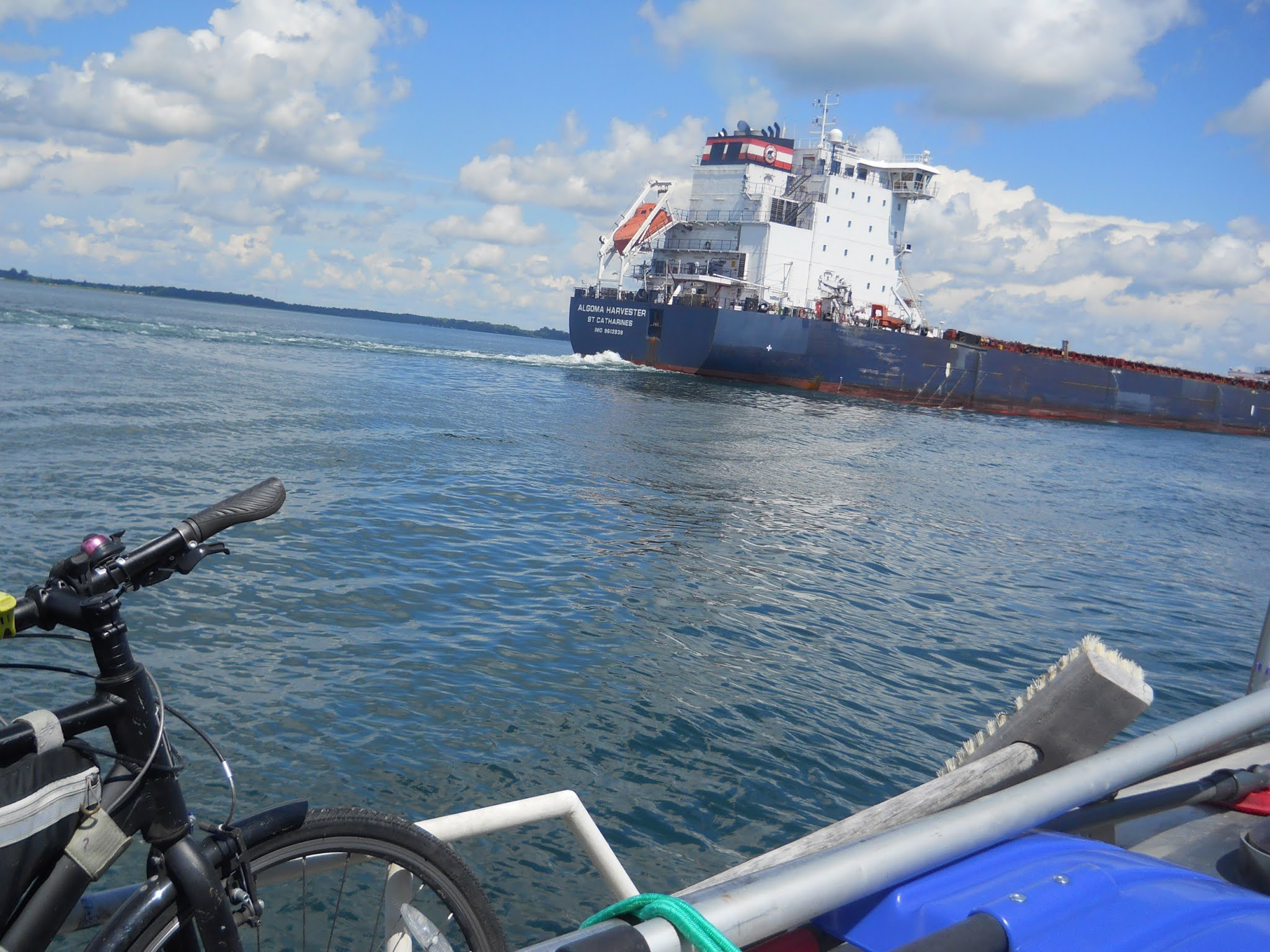
Somewhere in the St. Lawrence Seaway, a hairy lad keeps watch

It's been a busy time since the placid events of Kingston. We left for Brockville (anchored behind an island) and Cornwall (marina) in the St. Lawrence and anchored out for the first time on this journey. We got used to avoiding huge ships. They were numerous, but actually courteous compared to the wake-producing legions of powerboaters and jet skiers. Eastern Ontario and Western Quebec are stuffed with them.
When a ship goes by the anchorage at 0500h and you have the old camera set to "manual".

We entered the lock system at Iroquois, but just prior to that, we stopped at Iroquois Marina, a very isolated place down one of the previous iterations of canal, as is common on the Seaway, where ghostly pieces of former infrastructure abound. Making the turn into Iroquois Marina, we ran lightly aground. Alas, it was a taste of things to come.

Becky says there is a heron of some sort in this photo. I could hear a banjo.

We were pulled off by the staff easily enough, and one of those fine fellows, Matt, mentioned he had gone down to Nova Scotia to retrieve some sort of boat yard equipment. Turns out it was from Hubbards and the East River Ship Yard, o/o Bradison Boutellier. The fact that I should drop in to a marina that resembled something from "Deliverance" only  to meet a guy who knows a guy I know is one of the mysteries of sailing. Or, as is the case in a confined channel, mostly motoring.

Having reprovisioned in Iroquois, which, like so many small Ontario towns, seems to be devoid of people under 50, we transited our first lock. It was, as a lock, a doddle...there's only one foot difference at either end and I guess they only bothered to erase some minor rapids there naturally. However, the tone to come was set in which "hurry up and wait" became the standard. The process is straightforward: download an app to one's phone, call a number at 8 AM and book the next lock or two you think you can arrive at either in the morning or the evening. Then pay the $25.00/lock fee. You are then emailed a receipt for your reservation. You must make said reservation, and slots go quickly in this time of COVID. Boats cannot raft up and only 11 are allowed through either upstream (southwest to the Great Lakes) or downstrean (northeast to the sea). We watched the website like hawks, even as we soon discovered that the "A.M." and "P.M." pleasure craft lock-throughs were a touch fanciful, in that they were entirely subject to commercial traffic, of which there was a great deal, and could in fact happen at, say, 1630h and 1830h, meaning one could arrive at 1000h and basically piss up a rope either tied to a dock one was not permitted to leave, or circle endlessly in the approaches with 10 other vessels waiting for the lights to change.
Said traffic. While we were wary of ships, they were very steady and predictable and we had no issues with them.
Good thing I got the solar panels hooked up.
Another one on Lake Francis. Even at 12 knots, they didn't throw the wake a powerboat did.

Past the first lock, we stayed in a "canal marina" and managed to clip a sunken crib (a stone remnant of the previous canal). We did no damage to the rudder (it was a pretty minor tap), but we mnst have turned or otherwise unseated the nut securing the pin to the plate and the hydraulic ram arm. This became obvious later.

We went down an American canal to the two American locks. The weather was fine, but very gusty, at about 25-30 knots from aft. The "pleasure craft waiting area, as seen below, advertised six feet of depth.
And to think I used to like Eisenhower.

We draw five foot 10 inches on our full keel.  Becky spotted the vcry small, very literal buoyed area a little late, and I made a sharp turn...right onto shallow ground. This was problematic.

This is Edward's boat. It didn't end well for him, either.

This is Edward's blurry powerboat. He attempted to haul us off, for which I salute him, but he couldn't get much accomplished, and managed to foul his own props with our tow line. He also drifted into even shallower shallows. What a day it was turning out to be.

After several hours of blackening the oil in an attempt to reverse off with no result save some spinning, and a few more hours of bumping as the howling wind lifted us slightly and then dropped us three inches, I had to admit defeat. I called a U.S. Sea Tow outlet. Their first question was "do you have tow insurance?"

No, we did not.
It's hard to express how depressing this was. I stared more at this evil little nav aid for hours.

They put a towboat (a Stanley with a 150 HP outboard on it) from 70 miles away and drove to where we were. By this point, it was dark. After Herculean efforts, including a fresh regrounding, we were able to dock for the night. We also had Edward taken off. His props were unwrapped and it was discovered that only one of two was slightly damaged. Huzzah! Cost: $3,240 U.S. The U.S. dollar Visa card howled.
Note the evil buoy. I would say we are inside its six-foot demarcation. It begged to differ. That ship was requested by the lock staff to veer slightly port in order to give us enough "wash" to bump us free.

The next morning, full of hope and relief, we turned tightly off the dock and ran aground. Again. We nearly lost our tiny minds. More phone calls, more waiting. More pumping out the water tanks to lighten our load and (futilely, as it turned out) attempt to self-refloat. And while the integrity of the hull appeared to be intact, a nasty squeaking from the rudder's nether regions confirmed the pin was loose in its socket, meaning I had to break out the tiller and hand-steer.
Alas, the wash was a wash-out, although we did do a dramatic lurch of promise

Eventually, two different Sea Tow guys showed up and hauled us off stern first. Our bowsprit smacked the rubber fenders at the end of the pier, looking like the boat had had lost, not won, a fight. Cost: Another $3,240 U.S.
For a place with Homeland Security, they didn't even want to see our passports

The passage through the U.S. locks was as leisurely as any other, but made complex by the need to lasso floating bollard things, which proved difficult for Becky and Lucas and myself, trying to maneuver under tiller and not prang the wall. But we got through.

The slot in which the bollard thingie rises and falle.

The St. Lawrence widened into some pretty lake-like stretches after this, but, hand-steering as I was in some pretty impressive currents (8.8 knots with the diesel at just 1500 RPM), I did not stray far. The weather on the way to Cornwall deteriorated a bit and I was, frankly, a little paranoid. We stayed in the marina for a couple of days while I sought to find the right nuts to repair the job. A very nice contractor named Ben, who wishes not to be identified further, loaned me a massive 3/4" socket wrench and gave me a beefy 7/8" coarse threaded nut as are found, evidently, on hydro towers. This did the trick...but wait, there's more.
More ships!
More scenery!

More locks!

More random maintenance!

The Canadian locks were simpler to handle: two 1/2" poly lines were dropped from the top and simply eased around a bollard as we descended sedately. But the waits to get our slots were even longer: I estimate 24-28 hours of waiting over the five Canadian locks, mainly because of "more ships".
Looking a little rough there, Prime Mininster
Off, I believe, to Hamilon.

AIS has been, in actual practise, a positive boon in running down the river. We get constant updates as to speeds, closing times, distances of closest approach and other nerve-settling data. Because even the steel Alchemy is but a pop can next to these beasts, some of which bear evidence of mild collisions we didn't even want to dwell upon.
We were invariably the first to the "pleasure craft dock" and therefore had the longest wait times.

Slowly, we made our way to Montreal, but King Neptune, who operates on a franchise basis in these waters, had one more trick to play on us.
The view inside one of the locks, possibly Ste. Catherine

We had booked a morning lock transit for Ste. Lambert lock, the last one in the otherwise well-charted and buoyed Canal du Sud, a sort of bypass for those disinterested in the charms of the five-lock Lachine "pleasure craft" canal on the north side of Montreal Island. There was a yacht club in which we intended to stay, and while the area called "the lagoon" in which it was located was mysteriously unsurveyed, ourmarina guide claimed "two to three metres throughout".
The evil buoyage at St. Lambert. Not even once.

You can guess the next sentence. Go on, try.

We ran aground on a mud shoal. We were hauled off by a Zodiac with a 150 HP outboard driven by auxiliaries from Quebec's Garde côtière canadienne, and very effective they were. Our keel, once stuck on, only wants to back off. It took more time to fill out the form than to get off the mud. Cost: $0. I love my country.

We anchored in a very nice spot with very deep silt. That's the new Champlain bridge lit up.

We reversed back under the bridge (Champlain, old and new) and anchored out of the channel in about seven metres. The Spade anchor sets almost too well: we had to deal with a phenomenal amount of clay and silt the next morning and I had to use the old "rolling hitch on the chain run to the rope side of the gypsy" to get it in, as the chain side was slipping and complaining. But get it in we did.

Lucas is a big help, but he'll never truly enjoy upping anchor in seven metres of muck.
Bye, bye, mes ecluses!

Two guys we met in the six-hour wait for St. Lambert lock, Denis and Marc, were going to Port de plaisance Real-Bouvier and offered to prompt us on the VHF over the depths at the entrance, which looked dodgy and featured a slewing two-knot current, as is typical in the river. We got in with only mild tachycardia, and have reprovisioned in the suburb of Longueuil...

Took much of one afternoon to rearrange the anchors and clean off the filthy foredeck


...to rerun the anchors for less friction...
Inclinometre Velcro'd in place. Bought at Valleyfield for $10!

...made some minor improvements...

Boring, I know.

...and started on the more important job: a more permanent fix to the "pin" connecting the hydraulic steering ram to the rudder. As recounted above, we lost the nut to this last week in a graze with an old stone crib, and have replaced the nuts in the water twice with some difficulty as the rudder plate the pin (think something 7/8" thick) is about two inches below the water, which is fine for hand tools, but not electric drills. Add to this the aspect that to actually examine the pin means removing the entire rudder...I've only seen this part once, when Matt Phillips and I installed the Variprop and a new shaft and other goodies circa 2014 (see www.alchemy2009.blogspot.com for details if you like that sort of thing).

Cotter pin dryfitting.

So I've drilled a 7/8" nut (obtained at the perfectly stocked Demers Quincallerie Industrielle....think Atlas combined with Pacific Fasteners in Toronto) where my French was sufficient to get the nuts, the washers, and the two obscure sockets needed (1 5/16" and 1 7/16"!) and a 3/4"-1/2" reducer so these massive sockets can go on my biggest rachet wrenches/rbreaker bars.

We've assembled one of the tenders, crank on one of the nuts and a flat washer, hang a Dremel from the aft cabin portlight and use my Dremel's 36 inch extension with a 1/8" drill bit to drill into the existing holes in the nut, through the pin and then to insert and secure a SS cotter pin, which won't bear much force, but *will* prvent the nut from backing off.

One of these already fell off into the drink...because it's not yet pinned.

Fingers crossed, this will preserve the non-tiller steering (and the autopilot, which is very welcome in weather like this) until Halifax, in which the shipyard to do list now includes a replacement of this pin at the very least, and perhaps a rethink of how the rudder and the hydraulic arm are connected overall. Oh, and the wisdom of having a workshop on board is ever more clear.

We managed yesterday to get a good start, but the Dremel's too fast, so I'm going to hang my 500 RPM Makita drill lashed to the boat and use a Miles Orbiter to drill, slowly, through the SS pin. With luck, it will get through to the other side, I can pin it securely and we can be on our way.

Sunset over the Cardassian Embassy.


Wednesday, July 22, 2020

Then and now, now and then

Mrs. Alchemy can get jodgy about the tying off. So can we all.

DAY 7: Kingston, Ontario

We're in Kingston to see a friend and, oddly enough, to score some needed solar panel accessories. Note the end of the finger dock. Sweet. We like this compact club, as well.
Prinyer's Cove. Worth the drive to Adolphus Reach
We spent the evening of a long day's motor (the wind was strong from dead aft and we had some tricksy channels to navigate) in a quiet cove at anchor. We haven't anchored out much yet with this 30 kilo SPADE and 60 metres of chain, but we didn't budge all night, and the SPADE cut through dense weeds (which took 40 minutes to clear off) like a champ. The Thousand Islands will offer more opportunities, no doubt.

The anchoring went so well, we brought some of the bottom with us.

We had come from Trenton, where we spent three days (one free) at the Trent Port Marina, which is staffed well, but not exactly busy this pandemic season. But it's a good year for algae and muskrats.
Muskrat dinner is a little off-putting, really
We met the crews of "Other Woman" and "Captain's Daughter" at Trenton, and expect to see more familiar faces before the locks from our old club. It's that kind of place.
Backing out with Cabin Boy ready to fend. Photo (c) Shannon Greer
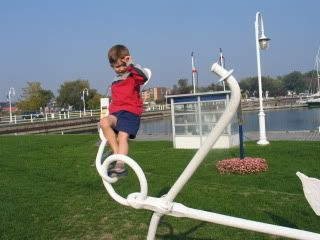
Prior to that was Cobourg, our traditional first stop, as it's a convenient 10-12 hour sail from Toronto. We left blindingly early in order to arrive while the COVID-proofed staff. The sight of the decorative ship's anchor reminded me of our boating history with this town, which has become a great deal more genteel over that time..
Lucas at age 4 (2005) in Cobourg Marina
Same lad in 2020...this is what happens if you feed them.
Today is a poring over charts day, as well as a provisioning day, as tomorrow we head down the St. Lawrence past the Thousand Islands, which shall be an interesting exercise in buoy-spotting. After that, the locks and the big letdown.

Thursday, July 16, 2020

The matter of gratitude

Signalling our departure.

DAY 2: Cobourg Marina, Lake Ontario

Last few days in the home port and, of course, it's stinking hot here and has been for weeks and there's still a lot of jobs to do. But the forecast looks promising for Tuesday, the proposed departure date, and, while only a fool of a sailor hews to a schedule, it's not a Friday.

As we prepare to leave, it seems appropriate to express gratitude for all the people in our lives who helped us, either via encouragement or through very direct aid, to reach this point. No sailor is an island, after all, and while we have certainly done a lot on our our initiative to become sailors capable of sailing a good old boat, there have been some folk who've been constant sources of inspiration and sound advice. In alphabetical order...

Jonathan Bamberger: We met at a 2010 "Safety at Sea" course (at which I also met the renowned Herb Hilgenberg) and he was kind enough to let me on his crew for the 2010 Lake Ontario 300 race. It provided more than one teachable moment.

Andrew Barlow: Has seemingly fabricated half the stuff on our boat and is a hell of a nice guy, as well. No matter how odd the task, he has been able to turn my crude diagrams into reality. I hope to one day finally jam with him, seeing as he's building a studio.
Now, as intended, completely full.
Fred Blair: This pal of my father-in-law, Dave McMurray, from back in the '80s when both were in the boat building realm, really came through for us with a beautiful custom-made cabinet for our galley, which has solved a host of stowage issues and made our galley fully functional.

Paul Bond
was one of the first guys I met at our boat club over 20 years ago and he and his wife Ruth-Ann were unstinting in their good advice and, later, when I stopped ignorantly damaging our first boat, were supportive when our plans for long-term cruising began to take shape.


Do not refrigerate this man's red wine.

John Cangardel has been so enthusiastic over the years on our behalf that his erudite and constructive advice has reignited our anticipation of actually doing this trip. More pertainently, he encouraged me to take two RYA courses aboard, one in Brittany, for which I was not entirely prepared, alas, but also another in Antigua, for which I was. Endlessly supportive, John will be our spirit guide as we go to places he's already been. And he also took the photo that is the background of the blog...our wake upon leaving Toronto Harbour.
Bruce Clark versus an Atlantic gale. Best to stay hydrated.

Bruce and June Clark: Gave me my first offshore crewing experience, and I must say, it was a doozy. Completed their own circ a few years back, and we still have the Portabote they sold us and it's not yet entirely shot. Were I to be deterred by the realities of offshore cruising, this trip might have done it...but I remained enthused.

Jeff Cooper: A consummate sailor in both racing and cruising modes, and a shrewd judge of the human condition, we shared the care and feeding and costs of my first boat, Valiente, and stayed friends despite that! Jeff is a brilliant bargain-finder, and aside from his considerable knowledge of good gear, he's been responsible for our acquisition of durable gear at reasonable prices, without which refitting would have taken longer and costs us more. He is so gracious, he never complained when I think he aggravated a hernia helping me bring an absurd number of large batteries aboard.

Dan Erlich: Another Viking 33 owner, Dan and I became acquainted via a mailing list back in the dark days of the internet concerning the repair and maintenance of the Atomic 4 gasoline inboard. Dan seems to know everything there is to know about this vintage motor, and was generous with his advice and guidance when I had to rebuild not one, but two of them, sourcing a block and parts that still run 15 years later for the new owner. Inventive and funny, Dan made motor mechanic skills acquisition easy.

Goshka Folda and Earl Bederman: Since 1996 (pre-boats!), Earl and Goshka were my primary clients for my freelancing efforts as an editor and graphic designer, Goshka, who now runs the firm Earl started, kept me working steadily and were very supportive of our goals to cut the dock lines.

Jay German and Rob Lamb: Fellow steel boat liveaboards and cat fanciers, Jay and Rob have been a source of friendship and sound steel boat advice for many years, and I expect them to get out of fresh water shortly after we do. Rob is particularly skilled at the art of winter battening-down, which helped us overwinter our boat last year.

Ken Goodings and Lynn Kaak: The couple with whom I took my Canadian Power Squadron Boating Course in 1999 as a know-nothing squib weren't a couple then, but they got married and sailed away on a Niagara 35 and have been taunting us ever since with tales of tropical paradises. Well, we're coming out shortly! Ken has given us excellent advice on the mysteries of the single-sideband radio (we are installing one this winter...finally) and is another marine bargain-hunter, as are all the best sailors.
Ian Grant works on his tan and his Zen-like calm.

Ian Grant: Antiguan-based, unflappable RYA instructor who managed to pack five days of instruction into a four-day week for my first step on the RYA ladder.

Tony Johnson is a boat repair guy so booked you might get him for 2021...but he has been very generous in giving me advice that allowed me to solve a difficult fuel supply problem satisfactorily. He is one of the few people in the boat trade local to Toronto I would recommend unreservedly....but be prepared to wait.

Mitch Kitz works for Genco Marine, as did my wife Rebecca for a few years when our favourite chandlery was on Queen's Quay West. Mitch's encyclopedic knowledge of boat gear, and his frankness in sharing his opinions, has served us enormously well in making the right decisions and using the right materials and techniques. If Mitch doesn't know the answer, you may be phrasing the question wrongly.
Alex baffled that Cabo S. Vicente was not "a washing machine" the day we rounded it.
Alexandre Mathias Kossack, whom I only knew from an internet comment site and a phone call, allowed me to visit him in 2007 and help him deliver his 12 metre raceboat Giulietta, which Alex, an engineer, had a large part in designing. He showed me, and later Rebecca on a later delivery, every courtesy. I didn't realize it when I met him, but he is one of the top amateur sailors in the world and competes now on a 53-footer at the ORC class level, and with a crew of Portugal's best young sailors. Boa sorte!

Suzanne Manvell has been "three-quarters" around the world by sailboat in her own right, and the love of boats brought her to us when we were attempting to sell our first boat, Valiente. While that didn't happen, we did become friends and Suzanne, a real estate agent par excellence (as well as a snappy dresser and a gifted dancer and party-thrower) ended up selling our Toronto home. When we missed our "departure window" in 2019, we decided to keep Alchemy afloat in a marina so as to make a quick exit in the spring. How that got sabotaged is still in the news, but, as we needed a place to stay, Suzanne unhesitatingly offered a flat in her house. This was after finding us a different flat post-house sale in 2018-19. Now I recommend her, again, unreservedly.

Dave McMurray is my wife's father, my son's grandfater, a former boat designer and builder and the man who didn't shoot me when, at age 31, I started dating his 19 year-old daughter. He has been unfailingly generous with his time and energy, including multiple trips shuttling possessions into storage, as has his wife Joan, and, despite knowing of our skills deficits, has been a great supporter of our efforts to get this old girl to the ocean.

Aubrey Millard, who, only coincidentally, was the husband of a dentist I had decades ago, owned Veleda IV, an Ontario 32 he and his wife Judy had sailed for many years. In 2010, Rebecca was given a chance to crew for him from the Bahamas back to Lake Ontario. Alas, mechanical and rig breakages put an end to that plan by South Carolina, but Rebecca learned a great deal on the voyage, which still informs us both today.

Matt Phillips is not only a friend since high school, a gifted director of photography, a B&B owner and a fellow steel boat owner, it's his influence I can credit, or blame, for getting me (and us) into sailing over 20 years ago. Constant as the northern star has been his friendship and his counsel.

Dave Rogers is a RYA instructor based out of Vaannes in Brittany and while I faffed my Yachtmaster course by forgetting the difference between IALA A and B, he still impressed me enough that I recommended Becky take her Day Skipper course with him, which she passed. I suspect we'll be sailing with him again on Tamara.

Andy Schell and Mia Karlsson are the couple behind 59° North, a charter outfit with a strong adventure and educational streak, and the people who gave a very informative day-long seminar I attended a couple of years ago. Andy was raised on a boat from childhood and is not only a person who sails expertly, but who also thinks about sailing constantly. His wife Mia, by contrast, didn't sail until she met Andy, but is now his equal. They are very positive people, and as an aspiring geezer, it's very heartening to see people 20 years my junior so deep into the adventure cruising lifestyle.

Paul and Sheryl Shard are probably the pre-eminent Canadian sailing couple. Via their Distant Shores media mini-empire, they've shot hundreds of hours of cruising lifestyle shows, given hundreds of seminars and presentations and worked probably more boat shows than they care to remember. Yet they remain very approachable and friendly, down-to-earth people whose love of sailing remains undimmed after three decades. I've learned a lot from that attitude.

And lastly, we've been members of National Yacht Club in Toronto for 21 years. Arriving first as crew and, four months later, as boat owners, we came there thanks to proximity to our house, but stayed because of the myriad kindnesses we were, and continue to be, shown by its members, some of who now are passed on. Particularly when we spent three years cradled in the parking lot, at various points minus diesel, roof and batteries, and were even more of a dusty, sweary, sweaty, annoyance than usual, we were shown near-infinite support, aid and good advice,including the teaching of sailing by patient instructors to our son, and that is why we eventually pulled this off. Thank you all so much.
So long for now! Photo (c) Shannon Greer

Monday, July 6, 2020

By way of introduction...

S/V Alchemy, the vessel in question, May 1, National Yacht Club, Toronto, Canada
Hello there, gentle readers. Most of whom I will assume are new, and some of whom have travelled from our sister blog of some antiquity, which describes how our crew and vessel have taken several years to get to this place, from which we plan to encompass the world.
The Cabin Boy predictively renders a verdict on future pretension.
All right, perhaps that's a pretentious introduction to be avoided in the future.


The point of this blog and the main cast

Our goal here is simple: to share with our readership, some of which I suspect will migrate from my venerable "repair and refit" blog, to follow our adventures by sea and land and see as we see the world in which we live. We plan to feature a lot of photos, eventually videos and even drone and underwater media, both of which we've found impressive additions to the blogs of other cruisers we admire, and some of whom we know, such as the fine people at Distant Shores and 59 North.

Our "take" will naturally develop as our journeys continue, but include those of a long-standing wildlife rehabber and holder of both a biology and teaching degrees and a man who never took a high-school shop class or owned a car, but who can talk about diesel repair with only a spot of drooling.

Also featured will be the views of our 18-year-old son, who was on a boat for the first time at five days of age and has had to listen to his parents talk interminably about the sea for much of the intervening time. It's going to be his world: his reactions to it should prove illuminating.

As noted, we are a three-person Canadian family, consisting of Lucas Dacey, 18 years old (he's much larger than in the above shot now); Rebecca McMurray (Mrs. Alchemy) and Marc Dacey (blogkeeper and alleged skipper). We live aboard S/V Alchemy, a Canadian-registered 12 metre, 16 tonne cutter-rigged steel motorsailer built in Ontario in 1988 and owned by ourselves since 2006. We have a long-held ambition to go around the planet in this boat, and to take five years or more to do it. We don't intend to rush, after all.

Alchemy in 2019, before some fairly signficant upgrades.

In 2018, we sold our house in Toronto and moved aboard in 2019. Technical difficulties precluded our escape to Canada's east coast for some shipyard tasks, and the current pandemic has delayed us further in 2020.

Until recently, that is. Our government allowed "pleasure craft" passage down the St. Lawrence Seaway as of Monday, June 22, and so we are in the final stages of preparing to leave for Halifax circa the second week of July. Our hesitation is related primarily to seeing if the near-inevitable "second wave" of this accursed pandemic threatens a fresh round of lockdowns and quarantines, as the only thing worse than not going at all this year, which, given the situation in Canada, was a strong possibility, would be to embark down the river only to be quarantined or otherwise stopped short of this year's goal, which is the Halifax region of Nova Scotia and a date with a shipyard to redo the bottom (essentially a paint job) and to rerig the mast. From there, we hope to cross the Atlantic in May, 2021.

The story of Alchemy


My wife and I joined the National Yacht Club in Toronto in the spring of 1999 as "crew". This meant learning to sail via a) an eight-week course and b) via joining the "crew bank" to supply bodies to the extensive sailboat racing contingent at the club. I was in my late 30s at the time and, while as yet childless, we had plans in that direction and had bought a house the previous year. When the internet service provider for which I worked as a marketing manager changed hands, I was given a modest sum to quietly go elsewhere. A sensible person would have shovelled the sum at the mortgage, but I decided by August 1999 to buy a sailboat of my own. Silly human!
Valiente, a 1973 Ontario Yachts Viking 33, hull 32, was named for an author we admired who diedon the day we bought her.
While my wife had grown up on boats, her familiarity was scanty in terminology and aspects of docking. She would happily go on the foredeck, however, to douse the sails in appalling conditions, which was good as I seemed to be able to steer pretty quickly. However, this was more "vintage hot rod" than "starter boat", and at 10 metres and 4 tonnes in weight, was interesting in terms of the learning curve. Also, we have never owned a car; I've owned a chainsaw and a moped, but I never took "shop" classes in high school, which was insufficient prep for dealing with a sailboat's auxiliary motor. The fact was this: I was woefully unprepared to own a boat, and mistaken, as is said, were made that led to a few scraps, a few repairs, and the rebuild of the engine. Twice.

Eventually, we got better, driven both by an urge to learn and, very quietly at first, the idea that one day, after the house was paid off and the baby grown, we might sail away to see the world. Not in the 33 footer, of course, but in a more suitable cruiser capable of taking on the ocean.
Like this steel Subrero Petit Prince 40 ketch
We had some guidance, which led to some preferences. My high-school buddy Matt Phillips had owned (and still owns) a beautiful Goderich 40 ketch in steel since the 1980s and we were keen on the perceived advantages of a ketch in terms of sail handling for a (as of the mid-2000s) shorthanded crew. Because our son was just a nipper at the time.

Unfortunately, while we did like the looks of that boat, we did not like its upkeep and it looked rough in terms of corrosion and general maintainence. While constant vigilance and a willingness to fix things are the foundation of any successful small-boat cruise, this is particularly true with steel boats, which can and do dissolve over time in salt water. The answer to these problems are attacking rust when found, and preventing rust in the first place. As this is a rather multi-faceted and deep topic, I will direct the interested to my "boat-fixing/refitting" blog, which goes not only into the technical side of cruising, but my years-long process of changing Nearly Every Damned Thing Aboard in order to bring the boat we did eventually buy fit for the purpose of cruising our big blue marble.

We paid off our house thanks to having tenants in the nicer half, not owning a car, not taking vacations and a lot of macaroni dinners in about seven and a half years. The bubblicious Toronto housing market allowed us to remortgage it a second time, which gave us a boat and a refit budget we judged to be adequate. As carefully built steel yachts (there are many home-built boats of varying grades of amateur skills) between 36 and 45 feet in length are pretty scarce, I thought I would have to fly ourselves and a surveyor to one of the many "cruiser graveyards", such as Panama, to see acceptable boats made available through disinterest or divorce. Because it's a sad fact that some couples do not realize that the reality and the dream of sailing don't match up as expected. Sure, there's the travel and the interesting people, but it's unrealistic to think that the "boat repair in exotic locales" will stop or even slow down once underway. For us, that's just the price to pay for the freedom to cruise, which is allied to the high levels of competence we feel we now possess. But it's too much for some, and there's boats ready to go at certain crossroads around the world priced to move.
Our first view of the place, nearly 15 years later, we call home.

So it was with mild surprise we came across a suitable candidate in our home town. Alchemy is a 42 foot LOA pilothouse cutter motorsailer in steel. Built in Kingston in 1988 as a custom project, we are her third owners, after the man who commissioned her from Phil Friedman, N.A. from his 1982 design, and from Chris Barrington, who fitted her out with decent gear only to find his life circumstances changed and a world cruise was not in the cards.
Comfort over speed, but who's in a hurry?
At circa 16 tonnes, Alchemy is no racehorse and her sail plan and full keel suggest a leisurely, if comfortable, lope around the world. But our budget did not allow for a "performance cruiser", but rather a boat that could carry us safely and self-sufficiently was what we sought. And, in June of 2006, she is what we got. And a fresh mortgage, paid off by 2018.

I was able to speak by phone and email to both the designer and to the man (Prof. B. Jones) who had what is clearly an ocean-capable vessel built for him more than once. Mr. Friedman was kind enough to send me copies of his original drawings (the real Alchemy as built unsurprisingly departs from these in some minor aspects. Mr. Friedman liked the results so much that he built himself a sister ship with a canoe stern; these are the only two vessels built of this type. Prof. Jones never found the time to sail her to salt water and she was a Georgian Bay cruiser for over 15 years. His loss was our gain, as she's got very little in the way of corrosion in her, which is the death of many a steel custom sailboat, and, as her surveys have determined, would cost nearly a half-million dollars to build today.

That's not what we paid.
Alchemy in 2015 underway with a full hoist. Photo (c) J. Cangardel
To some people, the idea of a custom, one-off boat is daunting. There are no owner groups, nothing is standardized and the damn swatches don't match. For us, however, dedicated to having the boat we needed, not the boat built to sell to sailors with different goals, having a steel boat has given us a free hand to change things to our plans and liking. The bones were sound, but we've done a lot of cosmetic surgery. In the process, we feel we've gained necessary skills in boat handling, repair, servicing and keeping the whole effort intact. We now look to transfer those years for a five-year (or more) voyage. Feel free to tag along. We leave next week (circa July 13, 2020).
The author, on an RYA course in Brittany in 2013, reviewing French nautical terms.


Friday, June 21, 2019

Moving on up...

Good for the long haul.
Departure is nearing...details to follow!